When we compare our lives to others, our peace begins to fade.
But David offers a different rhythm:
Trust in the Lord.
Delight in the Lord.
Commit your way to the Lord.
Wait patiently for Him.
This is not a strategy for success.
It is a posture of the heart.
🕊️ Word Spotlight: Commit (Galal)
The Hebrew word for commit in Psalm 37:5 is galal.
It literally means to roll something away from yourself onto another.
The picture is powerful.
Imagine carrying a heavy stone.
Then someone stronger invites you to roll it onto their shoulders.
That is what God invites us to do with our plans.
Not asking Him to bless our path.
But inviting Him to lead it.
🌿 Why Delight Comes Before Direction
The order of Psalm 37 matters.
First comes delight.
Then comes commitment.
Then comes God’s help.
When we delight in God’s presence—through prayer, worship, and Scripture—our desires begin to change.
God does not simply grant our desires.
He reshapes them.
And once our hearts align with His, our steps begin to follow His wisdom.
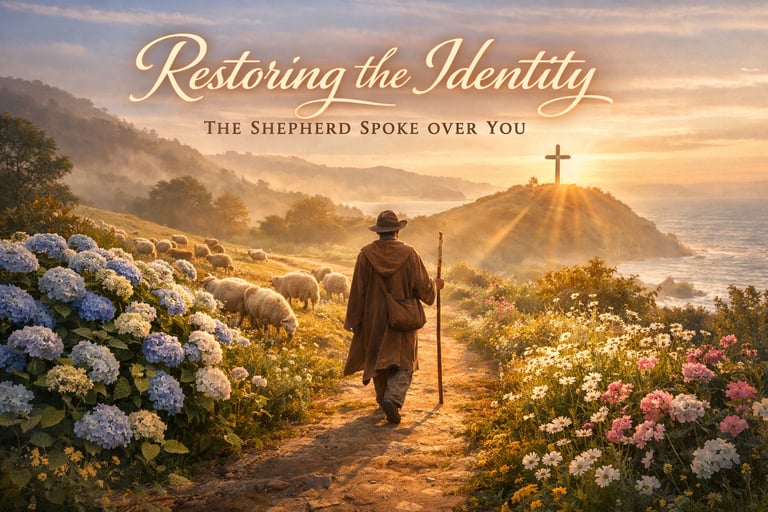
🌿 The Shepherd Still Leads
Psalm 37 echoes the words of Jesus in John 10.
📖 “My sheep listen to my voice; I know them, and they follow me.”
— John 10:27
The sheep do not force their own direction.
They recognize the Shepherd’s voice and follow.
Direction in God’s Kingdom rarely arrives as a detailed map.
It unfolds through relationship.
And when our delight rests in Him, direction begins to flow naturally from surrender.
🌷 Closing Blessing
May your heart find rest in the truth that you belong to the Shepherd who calls you by name.
As you delight in His presence and entrust your plans into His hands, may your desires be renewed, your steps directed, and your faith strengthened in every season.
Because when the Shepherd leads, every step—even the unseen ones—is part of His faithful direction.
🌿 Continue your journey of faith at
HisWordsMinistry.com
Discover devotionals, reflections, and resources to strengthen your walk with Christ.
With grace and encouragement,
Faitheful Pen
His Words Give Life
Many believers quietly carry the same question in their hearts:
Am I where God wants me to be?
We watch others moving forward—building platforms, launching ministries, reaching milestones that seem measurable and clear. And somewhere beneath the surface, a quiet pressure begins to grow.
Am I behind?
Did I miss something God wanted for my life?
Why does direction feel so unclear?
In moments like these, we often begin searching harder for answers—reading more, planning more, asking God repeatedly to reveal the next step.
But Scripture gently reveals something surprising.
Before God gives direction, He restores identity.
In John 10, Jesus describes Himself not as a strategist or a taskmaster, but as a Shepherd. A Shepherd who calls His sheep by name, leads them safely, and gives them a life that is rich with belonging.
The abundant life Jesus promised is not measured by visibility, income, or achievement.
It is measured by something far more secure:
Living under the care of the Shepherd who knows you.
And once that identity settles in our hearts, something beautiful begins to happen.
The pressure to prove ourselves begins to loosen.
The noise of comparison grows quieter.
And our hearts become ready for the next step.
Because direction in God’s Kingdom does not begin with strategy.
It begins with surrender.
In this two-part reflection, we explore how the Shepherd first restores our identity—and then gently directs our steps.
🌿 Part 1
Restoring the Identity the Shepherd Spoke Over You
John 10:10 — What Abundant Life Really Means
📖 “The thief’s purpose is to steal and kill and destroy. My purpose is to give them a rich and satisfying life.”
— John 10:10 (NLT)
John 10:10 is one of the most quoted verses in Scripture.
But it is often misunderstood.
For a long time, I heard this verse used in conversations about visible growth—expanding platforms, increasing income, entering what some call “six-figure seasons.”
The message was subtle but consistent:
Abundant life meant measurable increase.
And if you were not experiencing that increase, a quiet question would begin to surface.
Am I behind?
Am I misaligned?
Am I lacking faith?
So when I first read John 10:10, I instinctively filtered it through the world’s definition of abundance.
Growth.
Visibility.
Revenue.
But that is not what Jesus was describing.
When I slowed down and read the entire chapter, something became clear.
John 10 is not about income.
It is about a Shepherd.
🌿 The Context We Often Skip
In John 10, Jesus contrasts Himself with false shepherds—leaders who do not truly care for the sheep.
Hired hands who abandon them.
Voices that scatter instead of secure.
The thief comes to steal, kill, and destroy.
But what does he steal?
In context, it is not money.
It is identity.
It is security.
It is clarity about who you belong to.
Abundant life in John 10 is life under the care of the true Shepherd—life where your belonging cannot be exploited and your worth cannot be monetized.
Jesus was not promising six figures.
He was promising security under His voice.
🌿 The Subtle Drift
Over time, I began hearing John 10:10 quoted in business language—attached to financial breakthrough or visible expansion.
But Scripture cannot be bent to support our ambition.
If abundant life means revenue, every quiet season feels like failure.
If abundant life means visibility, comparison will always steal your peace.
If abundant life means numbers, your worth will rise and fall with them.
But in John 10, the sheep are not praised for productivity.
They are protected because they are known.
Abundance is not proven by income.
It is proven by belonging.
And belonging cannot be scaled.
🌿 A Personal Reflection
For many years, I carried a quiet label in my heart: uneducated.
I worked in the educational world surrounded by people with master’s degrees and PhDs. Meetings often turned into conversations about dissertations and academic accomplishments.
Sitting in those rooms, I often felt like an outsider.
Promotions passed by more than once with the same explanation:
You don’t have the degree.
Even when I eventually stepped into more senior roles, there was always a reminder attached to it. I was paid less than others because I did not have that piece of paper.
Over time, those experiences quietly shaped how I saw myself.
The world had a way of telling me what I was not.
Not educated.
Not qualified.
Not someone expected to move beyond routine work.
But during a yearly evaluation, my director said something that stayed with me.
She told me I was a learner—someone who genuinely loved to learn.
Then she said something else.
She said I had a knack for editing.
I wish I could remember every word she spoke that day, but those two statements stayed with me.
A learner.
A knack for editing.
Looking back now, I know with certainty that God used that voice to minister to me.
Not as a gentle whisper.
But as something that felt like a direct calling—an awakening of language I had rarely spoken over myself.
I can.
I am.
Those words shifted my thinking.
The world had been telling me who I was not.
But God was revealing who He created me to be.
The world said I was not educated.
But God said I was a teacher.
The world said my work would remain ordinary.
But God said I was a writer.
The world said my voice did not carry authority.
But God said I could counsel, encourage, and speak life into others.
What the world called limitation, God was quietly using as preparation.
As I look at my life today, I am still in awe of how He used that journey to build His Words Give Life.
I spent years striving for direction.
But the Shepherd was first restoring my identity.
🌿 Where Direction Begins
Before God directs our path, He restores our identity.
Once our hearts understand that we belong to the Shepherd, the pressure to prove ourselves begins to fade.
And that is where the next step begins.
Psalm 37 shows us what happens when identity is secure.
Instead of striving for control, Scripture invites us into delight and surrender.
Psalm 37:4–5
📖 “Take delight in the Lord, and He will give you your heart’s desires.
Commit everything you do to the Lord. Trust Him, and He will help you.”
— Psalm 37:4–5 (NLT)
Psalm 37 was written by David to address something believers in every generation struggle with:
comparison.
The psalm begins with a warning:
📖 “Don’t worry about the wicked or envy those who do wrong.”
— Psalm 37:1
🌿 Part 2
Delight Leads to Direction